

The Family Care Conversation Guide
Important conversations. Thoughtful preparation. A clearer path forward.
Planning for future care involves more than deciding where someone might live or how expenses will be paid. It also means understanding personal preferences, coordinating family responsibilities, organizing important information, and ensuring financial and legal arrangements reflect current wishes.
This guide organizes those considerations into five important family conversations. Each provides a place to begin, questions worth discussing, practical preparation, and guidance on what to consider next. You do not need to cover every topic in one sitting.
How to Use This Guide
The five conversations are arranged in a suggested order, but every family’s circumstances are different. You may begin with living arrangements, financial concerns, legal authority, or whichever subject needs attention first. The person whose care is being discussed should guide who participates and what is shared whenever possible. Sensitive financial and medical information should be kept in secure personal records.
Gather relevant documents, identify available resources, and divide preparation among family members. Start with facts you need to learn before asking others to make decisions.
Use the questions to understand preferences, concerns, and practical limitations. Listen first, respect personal boundaries, and avoid trying to settle everything at once.
Identify what needs attention, who will follow up, and when to revisit the subject. The printable workbook provides space for your family’s notes and next steps.
Explore the Five Conversations
Open the conversations in any order. Each section includes preparation guidance, the reasons the topic matters, questions to discuss, and suggested follow-up. For families who want additional detail, each conversation also contains a complete set of planning considerations.
What Would Care Actually Look Like?
Care preferences, housing, daily support, meals, and transportation
What Would Care Actually Look Like?
Care preferences, housing, daily support, meals, and transportationIf you eventually needed help with everyday activities, what would matter most to you?
Why This Matters
Care needs do not always begin with a major medical event. Changes in mobility, difficulty managing household tasks, or growing transportation needs can gradually affect independence and quality of life. According to the Administration for Community Living, nearly 70% of people turning 65 will need some form of long-term services and supports during their remaining years. Many receive assistance at home rather than in a facility.
Understanding what matters most before circumstances change gives families more opportunity to evaluate appropriate arrangements. Staying at home may be preferable, but accessibility, the availability of caregivers, costs, and safety all affect whether that choice remains practical.
Source: Administration for Community Living — Long-Term Care Information
Who Should Participate?
Start with the person whose future care is being considered. Depending on their preferences, that may include a spouse, adult children, other relatives, or trusted individuals. The goal is to understand their priorities rather than make decisions on their behalf. Different topics may call for different participants, and the person receiving care should retain as much choice and privacy as possible.
Before You Talk
Consider what is known about the person’s current living situation, mobility, transportation, and daily support. Research local services such as senior transportation, meal delivery, home modification professionals, and nearby care options. Family members can divide this research so no one person is responsible for gathering everything. Preparation should identify available options, not predetermine what the person wants.
Questions to Discuss
- Where would you prefer to receive care if you needed help with everyday activities?
- Which aspects of independence, privacy, and personal routine matter most to you?
- Would living with a relative be appealing, or would another setting feel more comfortable?
- What activities, friendships, and community connections would you want to maintain?
- How would you feel about receiving help with meals, bathing, dressing, medications, or transportation?
- What changes would make you reconsider your current living arrangement?
- Who would you want involved if your needs or preferences changed?
See all planning considerations22 detailed items for families who want the complete list
Personal Preferences
- Identify the preferred setting for care: the current home, a relative’s home, assisted living, or another arrangement.
- Review daily activities that could require support, including transportation, meals, bathing, dressing, and medication management.
- Clarify the importance of independence, privacy, dignity, familiar routines, and personal choices.
- Identify who should be included in decisions and who should receive updates.
- Plan to revisit preferences after important changes in health, mobility, finances, or family circumstances.
- Consider how to preserve hobbies, friendships, community activities, and meaningful social connections.
- Explore regular visits, companionship programs, and other ways to prevent isolation.
Housing & Support Options
- Evaluate whether the current home can accommodate changes in mobility, accessibility, and safety.
- Identify possible modifications such as improved lighting, ramps, safer bathrooms, or other accessibility features.
- Research in-home caregivers, personal assistance, and household support.
- Compare independent senior living, assisted living, board-and-care homes, nursing facilities, and continuing care retirement communities.
- Explore adult day services and community programs that may make aging in place more practical.
- Consider whether living with an adult child or relative is acceptable and feasible for everyone involved.
- Discuss how changes in housing would affect family routines, transportation, social connections, and care coordination.
Meals, Nutrition & Daily Living
- Review the ability to shop for groceries, prepare food safely, and maintain regular meals.
- Explore grocery delivery, meal programs, and help with meal preparation.
- Identify how missed meals, inadequate nutrition, or limited food access would be noticed and addressed.
- Consider future support with cleaning, laundry, personal hygiene, and household upkeep.
Transportation & Mobility
- Discuss alternatives if driving becomes difficult or is no longer appropriate.
- Research transportation from family, community programs, accessible transit, or paid providers.
- Identify backup transportation for appointments, groceries, and other essential activities.
- Consider how reduced mobility may affect healthcare access, friendships, community involvement, and independence.
After the Conversation
Identify the care preferences that are already clear, the arrangements worth exploring, and the information still needed. Assign follow-up research where appropriate and revisit the discussion when circumstances change.
Use Conversation 1 to record what matters most, housing or care options to research, and daily living needs that may require additional support.
Find the printable workbook
How Would We Pay for Care?
Care costs, financial resources, insurance, and benefits
How Would We Pay for Care?
Care costs, financial resources, insurance, and benefitsIf care became necessary, which resources could help pay for it, and what would that mean for the rest of the financial plan?
Why This Matters
Long-term care can introduce substantial expenses that are not necessarily covered by health insurance. Medicare generally does not pay for ongoing custodial care when that is the only care needed. Families may need to rely on income, savings, insurance benefits, qualifying public programs, or a combination of sources.
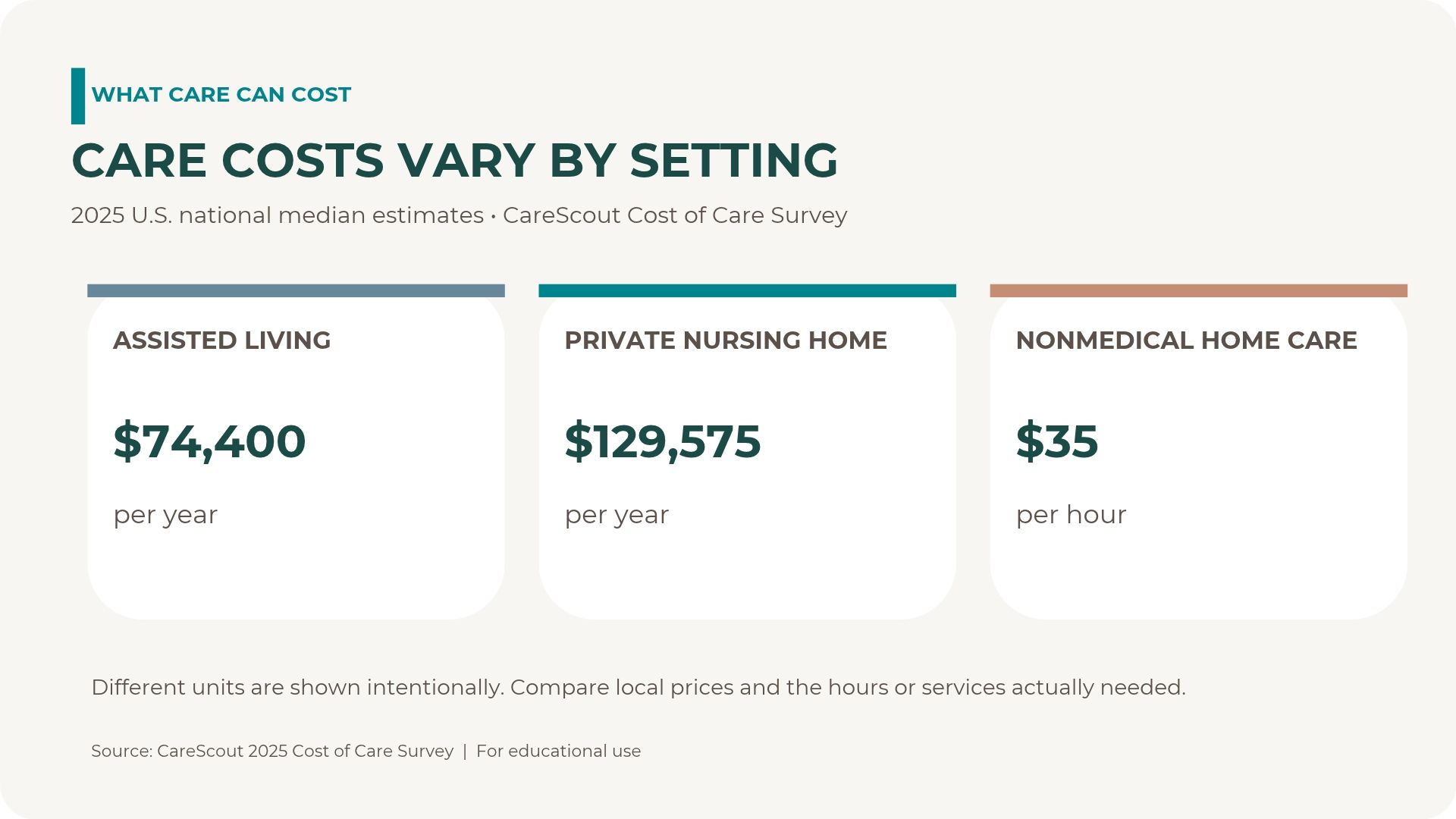
CareScout’s 2025 Cost of Care Survey reported national median costs of $74,400 annually for assisted living, $129,575 for a private nursing home room, and $35 per hour for nonmedical in-home care. Costs vary considerably by location, care setting, and services needed. A decision about care expenses can also affect the financial security of a spouse, future retirement income, and other family goals.
Sources: Medicare — Long-Term Care Coverage; CareScout — Cost of Care Survey and Calculator
Who Should Participate?
The person whose finances are involved should determine how much information to share and with whom. A spouse, an appropriately authorized financial decision-maker, or a financial advisor may be involved as appropriate. Family members who may provide care can benefit from understanding the overall plan without necessarily having access to individual accounts or balances.
Before You Talk
Research approximate local costs for in-home assistance, adult day services, assisted living, and nursing care. Gather existing insurance policy summaries, information about income sources, and the location of relevant financial records. Review the financial planning arrangements already in place, but keep account numbers out of shared notes.
Questions to Discuss
- What resources have already been set aside for future care?
- Would paying for care affect retirement income or the financial security of a spouse?
- What insurance coverage might help, and under what circumstances would it provide benefits?
- Who monitors insurance premiums and recurring financial obligations?
- Which expenses could arise beyond the direct cost of care?
- Have we explored Medicare limitations, Medicaid eligibility rules, or applicable veterans benefits?
- Who should help review the financial plan if significant care expenses become likely?
See all planning considerations28 detailed items for families who want the complete list
Understand Potential Care Expenses
- Research estimated care costs for the geographic area where care may be received.
- Compare in-home care, adult day services, assisted living, and nursing care.
- Evaluate how expenses could affect retirement savings, monthly income, household cash flow, and a surviving spouse’s financial security.
- Review whether the existing financial plan anticipates potential long-term care costs and how those expenses could be funded.
- Consider transportation, home modifications, medical supplies, meal services, and household assistance in addition to direct caregiving costs.
Organize Financial Information
- Maintain a secure inventory of financial institutions and the types of banking, investment, and retirement accounts held.
- Identify income sources, including Social Security, pensions, retirement distributions, and other benefits.
- Review retirement, spousal, and survivor Social Security benefits and possible effects of changes in household circumstances.
- Identify debts, recurring obligations, major expenses, and payment arrangements.
- Confirm where important financial records, Social Security benefit information, and relevant correspondence are securely stored.
- Determine which authorized individuals need to know how to locate essential information if the account holder becomes unable to manage their affairs.
Review Healthcare Coverage & Government Benefits
- Review existing health coverage, including Medicare, Medicare Advantage, Medigap, and prescription drug coverage when applicable.
- Understand the distinction between covered skilled care and ongoing custodial assistance that Medicare generally does not cover.
- Explore whether Medicaid might be relevant. Eligibility, coverage, financial rules, and reviews of earlier asset transfers vary by state and circumstances.
- Determine whether veterans benefits or other government and community programs may help with eligible services.
- Seek qualified guidance before making gifts, transferring assets, or changing ownership arrangements to pursue benefits eligibility.
Insurance Policies, Premiums & Coverage Continuity
- Prepare an inventory of life insurance, long-term care insurance, annuities, burial or final-expense insurance, and other relevant coverage.
- Identify the carrier, policy owner, insured person, type of coverage, and secure location of policy documents.
- Confirm whether coverage is active and whether policy benefits, exclusions, premiums, and terms are understood.
- Review payment arrangements, including automatic deductions and direct billing, and identify who monitors payments.
- Determine how missed payments would be noticed if a policyholder became ill or could no longer manage bills.
- Review premium due dates, renewal dates, payment frequency, and possible increases over time.
- Understand applicable grace periods, lapse provisions, reinstatement requirements, and premium-waiver benefits.
- Review life insurance death benefits, cash values, and any accelerated-benefit provisions.
- For long-term care policies, review covered services, eligibility requirements, elimination periods, exclusions, benefit limits, and claim procedures.
- Determine whether life insurance or annuity contracts include long-term care or chronic illness riders and under what conditions benefits may be available.
- Assess whether coverage remains appropriate and affordable before altering, replacing, or surrendering a policy.
- Review homeowners and umbrella liability coverage when relevant to the family’s broader financial situation.
Additional Reading & Resources
- CareScout Cost of Care Calculator
- Understanding Long-Term Care Insurance
- If Long-Term Care Insurance Isn’t for You
- Do Your Parents Need Long-Term Care Insurance?
After the Conversation
Identify the financial arrangements that are already understood, coverage that needs review, and potential gaps between expected care costs and available resources. Decide whether an insurance professional, financial advisor, benefits specialist, or attorney should help evaluate particular issues.
Use Conversation 2 to record potential funding sources, care costs to investigate, coverage questions, and responsibilities for monitoring recurring payments.
Find the printable workbook
Who Would Take On Caregiving Responsibilities?
Sharing responsibilities, caregiver support, and backup plans
Who Would Take On Caregiving Responsibilities?
Sharing responsibilities, caregiver support, and backup plansIf someone needed regular assistance, who could realistically help, and how could those responsibilities be shared?
Why This Matters
Family caregiving can require considerable time, emotional energy, and financial resources. According to Caregiving in the U.S. 2025, published by AARP and the National Alliance for Caregiving, nearly half of caregivers experienced negative financial effects related to caregiving, and approximately one-quarter incurred debt. The research covers a broad population of family caregivers, not exclusively people caring for older adults.
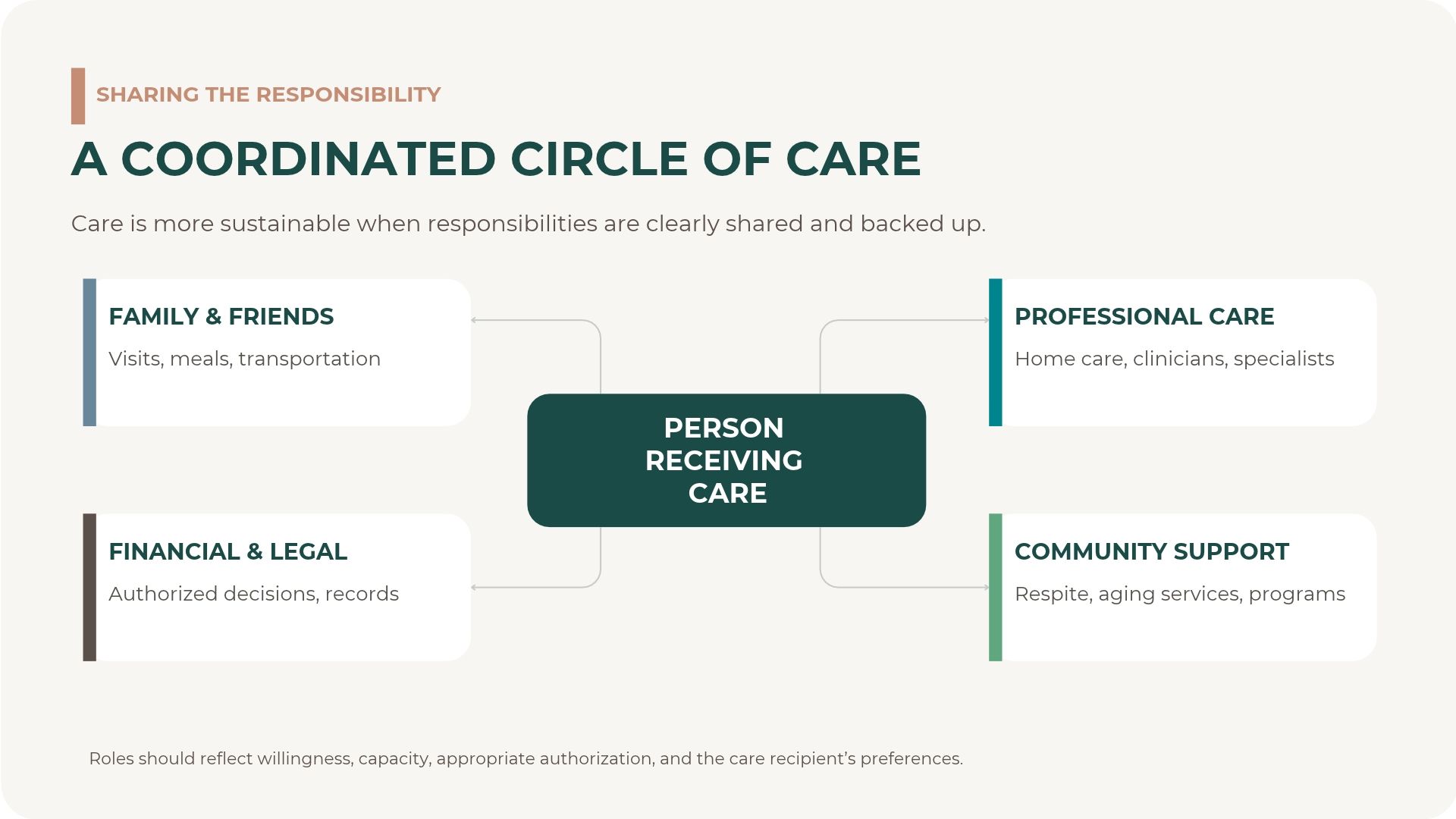
A workable care plan must consider the needs of both the person receiving care and the people providing it. Expectations that are never discussed can cause one relative to shoulder most of the responsibility or create financial consequences that emerge only after caregiving is underway.
Source: AARP and National Alliance for Caregiving — Caregiving in the U.S. 2025
Who Should Participate?
Include the person receiving care and the individuals who might actually provide support, with attention to the older adult’s preferences and privacy. Relatives who live nearby and those who would help from a distance may have different roles. No one should be assigned responsibilities without understanding their willingness, availability, and personal limitations.
Before You Talk
Identify the types of assistance that may be needed and gather information on community programs, home-care agencies, respite services, and local caregiving support. Each participant should consider their work schedule, family obligations, transportation capacity, and financial situation. Research professional assistance so the discussion does not assume family members must provide every service themselves.
Questions to Discuss
- What kind of assistance might be needed regularly?
- Who is willing and realistically able to help with different responsibilities?
- How could relatives living farther away contribute?
- Who might coordinate care and communicate with providers or family members?
- What financial or employment sacrifices could caregiving create?
- When would paid assistance or respite care be needed?
- What happens if a primary caregiver is unavailable or an emergency disrupts normal arrangements?
See all planning considerations23 detailed items for families who want the complete list
Identify Available Support
- Determine which relatives or trusted individuals are willing and able to provide help.
- Identify who lives nearby and who would coordinate or contribute from a distance.
- Discuss whether one individual should serve as the primary family coordinator or point of contact.
- Consider work commitments, household responsibilities, finances, and limitations for each potential caregiver.
- Identify services that may require professional assistance, including a geriatric care manager or local aging-services provider.
- When evaluating paid caregivers, review qualifications, references, services, fees, supervision, and complaint procedures.
Share Responsibilities
- Identify who could provide transportation or arrange rides for appointments and essential errands.
- Determine who may assist with grocery shopping, meals, household activities, and regular check-ins.
- Identify who may help coordinate bills, insurance communications, and professional correspondence, subject to appropriate authorization.
- Consider who monitors recurring obligations such as insurance premiums, rent or mortgage payments, and utilities.
- Maintain a current medication and supplement list in a secure location accessible to appropriate caregivers and healthcare professionals.
- Identify who could help with Social Security benefit questions or report relevant changes to SSA, consistent with the agency’s authorization requirements.
- Agree on how updates will be shared and how disagreements or changes in responsibilities will be addressed.
Protect the Caregiver’s Financial Well-Being
- Consider whether caregiving might require reduced work hours, unpaid leave, or an employment change.
- Review potential effects on wages, employee benefits, retirement contributions, and long-term earnings.
- Identify out-of-pocket costs such as transportation, supplies, and expenses paid on the care recipient’s behalf.
- Discuss whether expenses should be shared or reimbursed and whether paid care could reduce an unreasonable burden.
- Research workplace benefits, family leave options, caregiver assistance, and respite programs.
Emergency Preparedness & Backup Care
- Prepare an emergency contact plan that identifies family members, healthcare providers, and essential contacts.
- Discuss what happens if the main caregiver becomes ill, travels, or is otherwise unavailable.
- Identify backup caregivers, temporary services, and respite options.
- Plan for medication access, medical equipment, transportation, and daily support during severe weather, power outages, or other disruptions.
- Consider whether a personal alert system or other emergency assistance arrangement is appropriate.
Concerns about unsafe care, abuse, or neglect deserve separate attention. The Safety & Financial Protection reference below explains warning signs and where to seek help, including situations that should not be discussed in a family group.
Additional Resource
The Eldercare Locator, a public service of the U.S. Administration for Community Living, helps connect families with local aging services. Call 1-800-677-1116.
After the Conversation
Outline realistic roles, confirm each person’s agreement, and identify services that will require professional support. Establish a method for family updates and an emergency backup plan. Revisit the arrangement when the older adult’s needs or a caregiver’s circumstances change.
Use Conversation 3 to organize caregiving responsibilities, possible support services, financial implications, and emergency or backup arrangements.
Find the printable workbook
Who Would Make Decisions if Someone Could Not?
Legal authority, healthcare decisions, and important records
Who Would Make Decisions if Someone Could Not?
Legal authority, healthcare decisions, and important recordsIf you could no longer make or communicate certain decisions, who would you want to help, and would they have the legal authority to do so?
Why This Matters
When a person cannot manage particular financial or healthcare decisions, family relationships alone may not provide the authority needed to act. Financial powers of attorney, healthcare directives, and other legal arrangements serve different purposes, and requirements vary by state.
Several common arrangements are also misunderstood. Naming a trusted contact on a brokerage account does not authorize that person to view balances, access the account, make transactions, or act as a power of attorney. Likewise, a financial power of attorney alone generally does not authorize someone to manage another person’s Social Security benefits. SSA has separate representative payee requirements.
Resources: FINRA — Trusted Contact; SSA — Advance Designation
Who Should Participate?
The person making these arrangements should lead the conversation whenever possible. Proposed financial agents, healthcare decision-makers, and successor decision-makers should understand the responsibilities involved and be willing to serve. An estate planning or elder law attorney can explain how documents work under applicable state law. Other family members do not necessarily need access to private legal or financial details.
Before You Talk
Locate existing powers of attorney, healthcare directives, wills, trusts, and related documents. Determine when they were prepared and whether the designated individuals remain appropriate. Identify where originals are stored, which institutions may have their own procedures, and what questions require professional review. Do not assume that being a spouse, adult child, or emergency contact automatically establishes legal authority for every decision.
Questions to Discuss
- Who would you trust to manage financial matters if you could not do so?
- Who should make healthcare decisions if you were unable to communicate your wishes?
- Are those individuals willing and prepared to serve?
- Have successor decision-makers been identified if the first person cannot act?
- Where are essential legal and financial documents stored, and who needs access?
- Are there gaps between who the family expects to help and who is legally authorized?
- How should the family respond if someone begins having difficulty managing bills or financial decisions?
See all planning considerations18 detailed items for families who want the complete list
Review Legal Arrangements
- Confirm whether a durable financial power of attorney exists, remains valid, and still reflects current wishes.
- Identify financial agents and successor agents, including whether they understand and accept their duties.
- Review healthcare directives, healthcare proxy appointments, and other medical decision-making documents.
- Determine whether healthcare providers have appropriate written authorization to share protected information when needed.
- Clarify how medical decision-making authority differs from access to health information.
- Identify an estate planning or elder law attorney to help evaluate missing, outdated, or potentially conflicting arrangements.
Organize Essential Information
- Locate wills, trusts, powers of attorney, healthcare directives, and letters of instruction.
- Identify where original legal documents are safely stored and who should be able to retrieve them.
- Maintain a current list of relevant financial institutions, insurance providers, healthcare professionals, and professional advisors.
- Identify the secure location of property records, tax documents, and applicable military service records.
- Establish how documents and contact information will be reviewed, updated, and provided to appropriately authorized individuals.
Understand Financial Account Protections
- Review whether brokerage or investment accounts have an appropriate trusted contact.
- Understand that trusted contact designation alone does not grant account access, transaction authority, or legal decision-making power.
- Consider Social Security’s Advance Designation program, through which eligible individuals can identify up to three people they would prefer SSA to consider as a future representative payee.
- Understand that SSA must appoint a representative payee when needed; an advance designation does not automatically appoint one.
- Review legal, tax, estate, and financial implications before adding a joint owner to a banking or investment account.
- Explore appropriate alternatives for bill-paying assistance and financial management with qualified professionals.
- Develop a process for addressing signs that a person is struggling to manage financial obligations or make decisions.
Financial exploitation and abuse concerns are addressed separately in the Safety & Financial Protection section, including guidance on account alerts, warning signs, and independent reporting.
Additional Reading & Resources
- TWP — Estate Planning: An Introduction
- SSA — Advance Designation of Representative Payee
- FINRA — Trusted Contact
- HHS — Family Access to Health Information Under HIPAA
- CFPB — Managing Someone Else’s Money: Guide for Agents
After the Conversation
Identify documents requiring professional review, confirm that designated decision-makers understand their roles, and establish a secure method for locating essential records. Review arrangements after important changes in health, family relationships, residence, or finances.
Use Conversation 4 to identify authorized decision-makers, document locations, unresolved legal questions, and arrangements requiring professional review.
Find the printable workbook
How Could Care Decisions Affect the Family Legacy?
Estate planning, beneficiaries, family expectations, and final arrangements
How Could Care Decisions Affect the Family Legacy?
Estate planning, beneficiaries, family expectations, and final arrangementsHow might future care needs change the plans you have made for the people, causes, and responsibilities that matter most?
Why This Matters
Care needs can change the financial assumptions underlying a family’s estate plan. Assets once expected to support beneficiaries or charitable commitments may be needed for housing, medical assistance, or ongoing caregiving. Beneficiary designations may also need review when relationships, responsibilities, or financial circumstances change.
If relatives provide substantial care, financial assistance or compensation can raise additional questions about family expectations, taxation, and public-benefit eligibility. Informal payments to relatives may be scrutinized as gifts or transfers in a later Medicaid eligibility review. A properly documented caregiving agreement, prepared with appropriate legal guidance, may help clarify expectations and the nature of payments.
Related resources: AARP — Personal Care Agreements; TWP — Beneficiary Designations
Who Should Participate?
The person making estate and legacy decisions should decide which family members or trusted individuals to include. A spouse, designated fiduciary, financial advisor, estate planning attorney, or tax professional may need to participate in specific discussions. Heirs do not automatically need access to private estate details. Conversations about fairness, caregiving compensation, and family expectations should respect the older adult’s wishes and decision-making authority.
Before You Talk
Review the existence and date of current estate planning documents, beneficiary designations, business succession arrangements, and any prior instructions about final arrangements. Identify significant changes in family circumstances, care expenses, or assets. Gather questions for the appropriate professionals before considering changes to legal documents, account ownership, or beneficiary designations.
Questions to Discuss
- Do existing estate planning arrangements still reflect your wishes?
- Could future care expenses affect what you intend to leave to others or to charitable causes?
- Would a spouse or dependent need additional financial protection?
- Are beneficiary designations consistent with your broader intentions?
- Should substantial family caregiving involve compensation or reimbursement?
- Are funeral or memorial preferences already documented and funded?
- What circumstances would prompt another review of the estate and legacy plan?
See all planning considerations18 detailed items for families who want the complete list
Review the Broader Estate Plan
- Review wills, trusts, and related estate planning documents for consistency with current wishes and circumstances.
- Confirm beneficiary designations on retirement accounts, life insurance policies, and other applicable assets.
- Consider how significant care expenses could affect expected inheritances and charitable commitments.
- Review whether a surviving spouse or dependent family member might require additional financial protection.
- Identify federal or state estate and inheritance tax matters that warrant qualified advice.
- For business owners, consider continuity, management, and ownership-transfer arrangements in the event of incapacity or death.
Funeral, Burial & Final Arrangements
- Discuss personal preferences for burial, cremation, memorial services, and related final arrangements.
- Determine whether prepaid funeral arrangements, burial trusts, designated funds, or other provisions already exist.
- Review whether burial or final-expense insurance identified in the insurance inventory is intended to help pay these costs.
- Identify any funeral provider or other organization involved in existing arrangements.
- Locate contracts, payment records, letters of instruction, and other relevant documents.
- Consider whether anticipated expenses are sufficiently funded and identify possible gaps.
- Determine who would coordinate arrangements and how immediate expenses would be paid.
- Confirm whether written instructions are current and appropriately shared with the individuals who may need them.
Address Family Caregiving Considerations
- Discuss whether a relative providing substantial care should receive reimbursement, assistance, or compensation.
- Consider whether a written caregiving agreement is appropriate, with guidance concerning legal, tax, and Medicaid implications.
- Discuss expectations surrounding gifts, financial support, and differences in caregiving contributions among relatives.
- Identify changes in health, relationships, assets, or family responsibilities that could warrant updates to estate documents or beneficiary designations.
Additional Reading & Resources
- TWP — Beneficiary Designations
- TWP — Estate Planning: An Introduction
- AARP — Personal Care Agreements
After the Conversation
Identify documents and beneficiary designations that need review, clarify any family expectations requiring further discussion, and determine whether legal or tax guidance is needed. Keep final-arrangement instructions accessible to the appropriate individuals and revisit the estate plan as circumstances evolve.
Use Conversation 5 to record estate planning questions, beneficiary reviews, caregiving arrangements, and final-expense matters that need attention.
Find the printable workbookSafety, Financial Protection & Where to Get Help
Abuse, neglect, and financial exploitation can involve someone a person knows and trusts, including a caregiver or family member. Concerns about safety should be addressed privately when necessary, rather than treated as an agenda item for a family meeting.

Recognizing Unsafe Care
Changes in personal safety, unexplained injuries, neglect of basic needs, isolation, or controlling behavior can signal that additional attention or professional help may be needed.
Financial Warning Signs
Unexplained withdrawals, unusual changes to financial accounts, unpaid bills, pressure to transfer assets, or unfamiliar people exerting financial control deserve careful attention.
Recognizing Abuse, Neglect & Unsafe Care
Warning signs may include unexplained injuries, fear of a particular caregiver, missed meals or medications, poor hygiene, unsafe living conditions, or sudden social isolation. These circumstances can have different explanations, but patterns that raise concern should not be ignored. Maintaining regular contact can help relatives and trusted individuals notice changes in someone’s well-being.
When concerns arise, listen respectfully, protect the person’s privacy, and consider independent assistance. If the person potentially causing harm is a relative or caregiver, do not expect the older adult to raise the concern in a group setting. When paid caregivers or residential facilities are involved, learn about the provider’s complaint process and available independent oversight.
Adult Protective Services may be able to investigate suspected abuse, neglect, or exploitation under applicable state law. Long-Term Care Ombudsman programs can address complaints involving residents of qualifying long-term care facilities. Responses should reflect the circumstances, preserve autonomy where possible, and prioritize immediate safety.
Protecting Finances & Personal Information
Financial exploitation can involve unauthorized withdrawals, pressured asset transfers, changes to account ownership or beneficiaries, unpaid obligations despite available funds, or a new individual exercising unusual control over someone’s financial decisions. Scams may impersonate government agencies, financial institutions, relatives, investment professionals, or technology-support providers. Unexpected requests for money or sensitive information should be independently verified.
Appropriate account alerts, secure document storage, and regular financial reviews may help identify unusual activity. Passwords, account numbers, and sensitive records should not be shared unnecessarily. A brokerage trusted contact gives the firm another person to contact in certain circumstances, but does not itself authorize that individual to access account balances or conduct transactions.
Someone who acts under a financial power of attorney must meet applicable fiduciary and recordkeeping obligations. Independent professional review may be valuable when financial activity is unclear, disagreements exist, or coercion is suspected. Concerns involving a potentially abusive relative should be addressed through appropriate independent channels rather than requiring the older adult to confront that person.
Where to Get Help & Report Concerns
The appropriate reporting option depends on the nature and location of the concern. Adult Protective Services may assist with suspected abuse or exploitation. Long-Term Care Ombudsman programs assist residents of nursing homes and other covered facilities. Suspected financial theft or unauthorized transactions should be reported promptly to the institution involved.
Investment-related concerns may also warrant a complaint with FINRA, the Securities and Exchange Commission, or a state securities regulator, depending on the firm, professional, and activity involved. Local law enforcement may be appropriate when a crime is suspected. If someone is in immediate danger, call 911.
Take the Conversation With You
The Family Care Planning Workbook provides space to organize preparation, record decisions, assign responsibilities, and identify next steps. Families can use it at their own pace and keep completed copies with their important records.
The workbook follows the same five conversations as this online guide, making it easier to move from discussing important questions to organizing practical next steps.

Additional Family Care Planning Resources
The following resources offer further information on long-term care costs, insurance, estate planning, and family caregiving. They can help families explore specific topics in greater detail.
From Tuttle Wealth Partners
Planning for Care Is Part of Planning for Life
Decisions about long-term care can affect retirement income, insurance, family responsibilities, and legacy goals. Tuttle Wealth Partners can help you consider how these priorities fit into your broader financial plan.
To learn more, contact Tuttle Wealth Partners at 800-871-1219 or visit tuttlewealth.com.